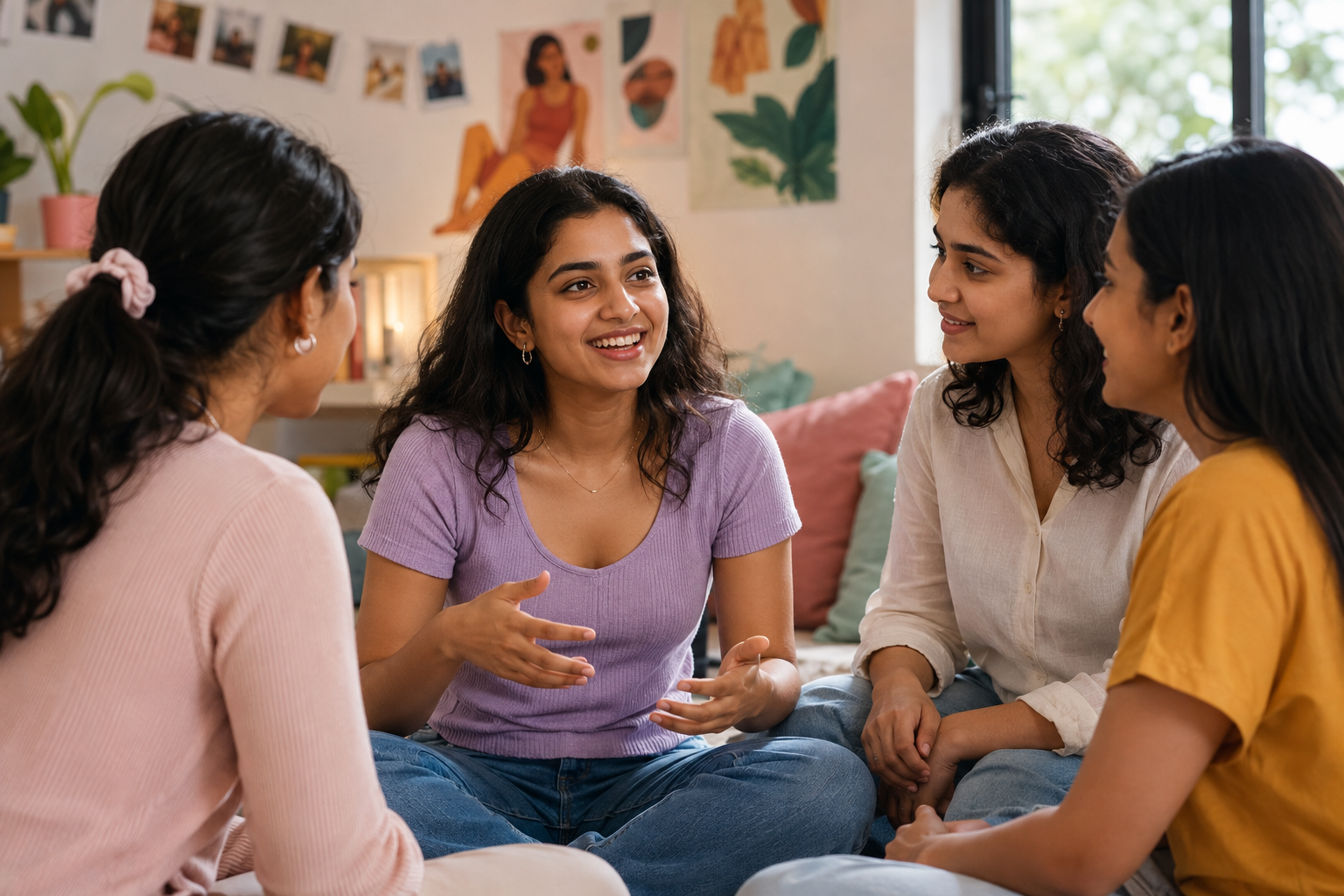
They talk about periods more openly than generations before them. But does talking more mean knowing more?
There was a time when saying the word "period" out loud could make an entire room uncomfortable.
A sanitary pad had to be hidden inside a newspaper or tucked into a bag.
Girls whispered to their friends when they got their first period.
Menstruation was discussed in code.
"Those days."
"Monthly problem."
"Not feeling well."
Anything except the word itself.
Then came a generation that grew up online.
A generation that talks openly about mental health, body image, sexuality, gender, reproductive health and social taboos.
A generation that can turn almost anything into a meme—and somehow make uncomfortable conversations easier to have.
Gen Z has made menstruation more visible.
Periods appear in social media posts, podcasts, YouTube videos, educational campaigns, memes and everyday conversations.
People talk about cramps.
They talk about period products.
They talk about period poverty.
They talk about endometriosis.
They talk about PMS.
They talk about menstrual leave.
They talk about the pressure to hide a period.
And perhaps most importantly, they talk about periods without always whispering.
So, is Gen Z actually more menstrual-health aware?
The answer is probably yes—but not as much as we might think.
Because there is a difference between being comfortable talking about menstruation and actually understanding it.
A generation growing up with information everywhere
Previous generations often had a very limited number of places to learn about menstruation.
A parent.
A teacher.
A doctor.
A school textbook.
Maybe a friend.
And even those sources could be surrounded by embarrassment.
Gen Z grew up in a completely different information environment.
If someone wants to know why periods hurt, they can search for it in seconds.
If someone wants to understand menstrual cups, there are thousands of videos.
If someone wants to know whether their period is considered "normal," they can find communities of people sharing similar experiences.
If someone wants to understand endometriosis, PCOS or period-related symptoms, there are entire online communities dedicated to them.
Research into young people's menstrual education shows that social and digital media have become important places where young people try to fill the gaps left by conventional menstrual education. In one qualitative study, young people described using digital content to answer questions that formal education had not adequately addressed—including the very basic question of "Am I normal?"
That is a major change.
The internet has made menstruation searchable.
And when something becomes searchable, it becomes easier to talk about.
From hiding pads to sharing experiences
One of the biggest changes may not be medical knowledge at all.
It may be visibility.
A teenager can now see someone online talking about cramps and realise:
"I'm not the only one."
Someone experiencing unusually heavy periods may come across information that encourages them to speak to a healthcare professional.
Someone who thought severe pain was simply something everyone experienced may learn that debilitating symptoms deserve attention.
Someone embarrassed about using menstrual products may discover that there are many options beyond the one product they were introduced to at school.
And someone who grew up believing that periods were dirty may encounter thousands of people challenging exactly that idea.
This matters because stigma thrives in silence.
UNICEF continues to highlight that stigma and lack of information can leave adolescents ashamed or unable to openly discuss menstruation.
The more visible menstruation becomes, the harder it becomes to maintain the idea that it is something that should never be discussed.
Gen Z talks about periods differently
There is also something uniquely powerful about humour.
Memes about period cravings.
Jokes about cramps.
Videos about the panic of getting your period unexpectedly.
Stories about asking someone for a pad.
They may not look like "menstrual education."
But they can still change the culture around menstruation.
Research examining how young people encounter menstruation in social and news media suggests that humour and memes can sometimes help young people question menstrual stigma, share experiences and create a sense of collective identity—even though the same spaces can also reproduce stereotypes and misinformation.
That distinction is important.
Not every conversation about periods needs to sound like a biology textbook.
Sometimes, making something ordinary enough to joke about is part of making it ordinary enough to discuss.
And that may be one of Gen Z's biggest contributions to menstrual health:
making menstruation less mysterious.
But here is the problem: the internet is not a classroom
More information does not automatically mean better information.
And this is where the story becomes complicated.
Social media has made menstrual health easier to discuss.
It has also made it easier for misinformation to spread.
One person posts a health claim.
Another person repeats it.
A third person turns it into a short video.
Soon, thousands of people have seen it.
The number of views becomes mistaken for credibility.
The confidence of the creator becomes mistaken for expertise.
And an anecdote becomes mistaken for medical evidence.
Research on health information online has repeatedly highlighted this problem, including concerns about misleading reproductive-health information and the influence of social platforms on health perceptions and behaviours.
So Gen Z may have more access to menstrual information than previous generations.
But access isn't the same thing as understanding.
Having Google in your pocket doesn't mean having a doctor in your pocket.
The "Am I normal?" question
Perhaps one of the most revealing aspects of today's menstrual-health conversation is how often people still ask:
"Is this normal?"
Is this amount of bleeding normal?
Are cramps supposed to hurt this much?
Is it normal to feel exhausted?
Why is my cycle irregular?
Why does my period disappear?
Why does it hurt when I exercise?
Why am I bleeding between periods?
Why does my mood change so dramatically?
The fact that these questions are being asked online is encouraging.
But the fact that so many people feel they need the internet to answer them also tells us something about our education systems.
We may have become better at talking about periods without becoming equally good at teaching menstrual health.
There is a difference.
We taught girls how to manage periods. Did we teach them how to understand them?
For decades, menstrual education has often focused on practical management.
How to use a pad.
How often to change it.
How to dispose of it.
What happens during menstruation.
These things matter.
But menstrual health education needs to go further.
It should help young people understand their menstrual cycle as part of their overall health.
It should explain what typical variation can look like.
It should teach people to recognise symptoms that may warrant medical attention.
It should discuss pain.
It should discuss heavy bleeding.
It should address conditions such as endometriosis and PCOS in age-appropriate ways.
And it should include boys too.
Because if only girls learn about menstruation, we are teaching half the population about something that affects the whole population.
UNICEF has repeatedly emphasised the importance of ensuring that children and adolescents can access accurate information and discuss menstruation without shame.
Gen Z may be changing who gets to be part of the conversation
Another important change is that menstruation is no longer being framed exclusively as a "women's issue."
People are increasingly discussing the experiences of transgender men and non-binary people who menstruate, as well as the ways disability, poverty, geography and access to healthcare affect menstrual health.
UNICEF explicitly recognises that transgender men and non-binary people can face discrimination related to menstruation and access to necessary materials and facilities.
This doesn't mean every young person has suddenly become perfectly informed about inclusion.
Far from it.
But the vocabulary of the conversation has expanded.
And vocabulary matters.
Sometimes, before society can change a problem, it needs to learn how to name it.
But is Gen Z actually less embarrassed?
This is where we need to resist the temptation to romanticise an entire generation.
Gen Z isn't one giant, perfectly progressive group.
A teenager growing up in a large city with unrestricted internet access may have a completely different understanding of menstruation from someone growing up in a community where reproductive health remains deeply taboo.
Culture still matters.
Family still matters.
Religion, community expectations, education, income and access to healthcare still matter.
And social media itself can create new forms of pressure.
The same platforms that encourage people to talk about periods can also create unrealistic expectations about what a "normal" period should look like.
The same influencer who encourages body positivity may promote an unproven supplement.
The same video that helps someone recognise a possible health concern may also encourage unnecessary anxiety.
The same algorithm that gives someone useful information can send them down a rabbit hole of increasingly unreliable content.
So perhaps the question isn't:
"Is Gen Z more aware?"
Perhaps it is:
"What kind of awareness are we creating?"
Awareness is more than knowing the word "endometriosis"
There is a growing vocabulary around menstrual health.
Endometriosis.
PCOS.
PMDD.
Period poverty.
Menstrual leave.
Cycle tracking.
Hormonal health.
Reusable products.
Sustainable periods.
This is progress.
But knowing the vocabulary isn't the same as understanding the conditions.
Someone can know what endometriosis is and still believe severe period pain is something everyone should simply tolerate.
Someone can talk about period poverty and still not understand how lack of access affects school attendance and dignity.
Someone can track their cycle every day and still misunderstand what their data is telling them.
Someone can proudly say, "Periods aren't taboo anymore," while still feeling uncomfortable asking a colleague for a pad.
Awareness has layers.
First, we hear about something.
Then we recognise it.
Then we understand it.
Then we know what to do about it.
And finally, we change our behaviour and our systems.
Gen Z is may be further along in this journey than previous generations—but we are nowhere near the end.
The generation that made periods visible
Perhaps the greatest achievement isn't that Gen Z knows more facts about menstruation.
It is that menstruation is becoming harder to ignore.
A generation that shares almost everything online has started sharing something previous generations were taught to hide.
That visibility can lead to education.
Education can lead to questions.
Questions can lead to medical conversations.
Medical conversations can lead to earlier recognition of menstrual disorders.
And open conversations can slowly weaken stigma.
But visibility alone isn't enough.
We need credible information alongside viral information.
We need healthcare professionals alongside influencers.
We need proper menstrual education alongside social-media conversations.
We need parents who can answer questions without embarrassment.
We need schools that teach more than just the mechanics of bleeding.
And we need young people to learn one of the most important digital-health skills of all:
not everything that sounds confident online is true.
Maybe Gen Z isn't the "menstrual-health aware" generation yet
Maybe it is the menstrual-health questioning generation.
And that might actually be more important.
They are asking why period products are expensive.
Why period pain is dismissed.
Why menstrual leave is controversial.
Why girls are still missing school because of periods.
Why menstrual products have historically been hidden.
Why people are embarrassed to say "period."
Why boys weren't taught about menstruation.
Why severe symptoms are normalised.
Why healthcare systems sometimes take years to recognise menstrual disorders.
Why there is still so much misinformation about something so biologically ordinary.
These questions are uncomfortable.
But uncomfortable questions are often where social change begins.
The generations before Gen Z may have inherited the silence.
Gen Z inherited the internet.
And now it is using that internet to talk.
Sometimes intelligently.
Sometimes imperfectly.
Sometimes with facts.
Sometimes with misinformation.
Sometimes with a meme.
But it is talking.
And perhaps that is the first major victory.
Because you cannot challenge a taboo while whispering about it.
You cannot improve menstrual health while pretending menstruation doesn't exist.
And you cannot build a healthier generation by teaching young people to be ashamed of their own bodies.
So, is Gen Z really more menstrual-health aware?
Maybe.
But the more important achievement is not that they know everything.
It is that they are no longer satisfied with knowing nothing.
They are asking questions.
They are sharing experiences.
They are challenging old beliefs.
And they are making conversations that once happened behind closed doors visible to everyone.
The next step is making sure those conversations are not just louder—but smarter, kinder and medically informed.
Because the future of menstrual health isn't simply a generation that talks about periods.
It is a generation that understands them.